
Update: OpenAI is shutting down Sora, and the deal between OpenAI and Disney is dead. Disney’s statement to Axios (at that link) says:
“We appreciate the constructive collaboration between our teams and what we learned from it, and we will continue to engage with AI platforms to find new ways to meet fans where they are while responsibly embracing new technologies that respect IP and the rights of creators.”
Personally, I think everything I wrote below is only more important now, but maybe I’m a bit biased (and self-satisfied right now).
Original Post Continues Here
Note: A version of this post originally appeared in the newsletter.
A while back, news broke that OpenAI and Disney reached a licensing deal that will allow Disney IP to be used by Sora and ChatGPT. I wrote about it in the newsletter, but here’s a slightly expanded version of those initial thoughts. (Relatedly, I apologize if anything is out of date as I finally get this up.)
Some highlights of the deal (paraphrased / edited where not quoted; emphasis added):
Three-year licensing agreement
Sora will be able to generate videos drawing on more than 200 Disney, Marvel, Pixar and Star Wars characters.
“Sora and ChatGPT Images are expected to start generating fan-inspired videos with Disney’s multi-brand licensed characters in early 2026.”
A selection of these fan-inspired videos will be available to stream on Disney+.
“Disney and OpenAI affirm a shared commitment to responsible use of AI that protects the safety of users and the rights of creators.”
Disney will become a major customer of OpenAI
Disney will make a $1 billion equity investment in OpenAI, and receive warrants to purchase additional equity.
Yes, I’ve Sora’d; Yes, It’s Fun
Let’s start with the fun part—if you haven’t tried Sora yet, it sounds like you’ll have good reason to do so soon. It’s a tool and social platform that you prompt with a description of a short video you’d like to create, and it generates a corresponding video. They’re pretty convincing. (You can browse it to see all it offers, but here's a panda boarding the subway.)
I’ve spent some time on the platform, and it is a lot of fun. I’ve even used it to generate short educational clips for Zoe on simple topics where, ironically, existing platforms have become saturated with hot garbage.
While I think there is a “big picture” discussion to be had about AI (and content consumption), the immediate takeaway for you is probably that this is going to be a fun new way for you and your kids to interact with Disney IP.
With that said, I’d like to at least wade into the “medium picture” discussion of how users and their content will fit into this new OpenAI-Disney relationship.
Respect, Copyright, Inspiration, and Generation
Let’s start with some bias. As a content creator myself, I’m highly suspicious of the claim that OpenAI is interested in protecting the rights of creators, but that’s a “rabbit hole” (Lewis Carroll, 1865) I won’t go too far down here. It’s nice to see any AI company paying anyone for the content they appropriate, but we’re still a long way from “R-E-S-P-E-C-T” (Aretha Franklin, 1967).
In discussing this post with Emily, she said I’m one of the less overtly anti-AI full-time content creators she knows. I think that’s probably correct, but not because I have some generic “pro-AI stance.” Indeed, I’m well aware of the existential risk AI poses to many, maybe most, content creators.
And the threat isn’t simply to “muh job.” Rather, the threat is to the quality of all content, even AI-generated content. It’s a mistake to think copyright law exists just because “fairness.” That’s part of it, but it also exists to incentivize people to create good content. Here’s an example of the downward spiral I fear:
I have a post explaining good EPCOT rope drop strategy
I make money when people read that post
I use the money to go to Disney World to keep the post updated
AI content generators reproduce that post, which takes views away from me
I make less money with fewer views
I can’t justify the cost of a trip to update the EPCOT rope drop strategy post
My EPCOT rope drop strategy post gets out of date as the parks change
AI content generators rely on outdated content to generate their content
AI content generators provide outdated EPCOT rope drop tips because the content they rely on is outdated
Everyone loses
Now, if the AI can get information on EPCOT rope drop from some other source, this isn’t a problem for you, the guest who wants to learn about EPCOT rope drop. But the above explanation shows why that information won’t come from existing sources, and new sources are less likely to publish without an expectation of monetizing.
Social media and forums perhaps provide a fertile source for AI, but I promise you the amount of EPCOT rope drop content out there—let alone that with actual thoughtful analysis—is not exactly a cornucopia. And, again, for this model to survive we have to be talking about purely beneficent creators, not people seeking a sustainable, income-generating platform.
Given that I think this is a very clear problem with no obvious off-ramp, it’s natural to ask why I’m not more of an alarmist about content-generating AI. Well, two reasons:
Resignation. If AIs can generate quality content, the best hope that smaller content creators have is forming some sort of collective that can successfully lobby world governments to impose policies that ensure they’re compensated for AI use of their content. This seems unlikely.
Further, institutional defenders of content creation rights—like legacy media that write mediocre, generic travel content—benefit from their smaller competition being run out of the marketplace. Those institutions are more likely to cut deals with AI companies or lobby for policies that work best for them. It’s hard to envision a path out of this, even if I sound an alarm.Skepticism. I saw a social media post a few weeks back that said something like “Anytime I talk to an expert in their domain, they know how stupid LLMs are. Unfortunately, most people aren’t experts in anything.” This accords with my experiences and my varying levels of expertise across a few different fields. I think many of us have been surprised by the wide range of use cases for LLMs. But I also think we’re finding more and more that LLMs are highly imperfect. It might be experts who realize this now, but you’re also seeing user reports of the “I planned this trip with AI but when I got to booking it made no sense!” sort. I’m admittedly not quite sure how this translates into more creative fields where Sora and image-generation are the “competition.”
To expand on point 2 (the less fatalistic point), I think the fact that we’re seeing the “death” of some forms of content creation doesn’t mean that all content creation is doomed. In the NiemanLab Predictions for Journalism 2026 report, Marie Gilot wrote:
Here’s the type of content losing to AI: explainers, how-tos, evergreens, aggregated news, resource lists, hours of operation for government offices, recipes.
The winning content? Hyperlocal news, breaking news (as it happens), scoops, notable first-person narratives, and investigative journalism. AI can’t or won’t summarize this information because it’s too recent or too unique.
Consider Sora again. Currently, the tool puts out short-form video. Some might call this content “brain rot”, and whatever your feelings on it I think there’s a big difference between AI displacing that content and AI displacing, say, the works of Christopher Nolan. (FWIW, there’s an undercurrent to everything I’m saying here, and it’s that garbage content isn’t anything new, and quality content creators have been competing with garbage content for a while now; garbage content has improved in quality and quantity, but it’s not necessarily a new kind of threat.)
Copyright law is at the center of this, and the issues appear in more way than one. As part of the agreement, a selection of the videos with Disney IP will be available to stream on Disney+. Attorneys at OpenAI and Disney, attempting to navigate the murky waters of AI copyright law, decided to characterize these videos as “fan-inspired” and “Sora-generated” in this announcement. (They do refer to the videos as fan “creations” at one point, though.)
I expect that people who create—er, “inspire”—these videos that wind up on Disney+ won't be compensated. I suspect paid professionals who create content for Disney+ won't appreciate having to compete with short-form user-generated (sorry again! "fan-inspired, Sora-generated") content, and as a user I will definitely resist any trend toward feed-style short-form content taking over yet another space.
“OpenAI? More like ‘Closed When the Mouse Is Involved’AI!”
Relatedly, you presumably won't be able to use your inspired content for your own profit off the Sora platform. This is something of a shift in the current way OpenAI's platforms work. So let's turn to that issue...
The OpenAI terms of use specify:
Ownership of content. As between you and OpenAI, and to the extent permitted by applicable law, you (a) retain your ownership rights in Input and (b) own the Output. We hereby assign to you all our right, title, and interest, if any, in and to Output.
The opening clause there is meant to cover a gap in the rest of the paragraph. Specifically, if you use OpenAI tools (including Sora) to generate output that violates some third party’s copyright, OpenAI isn’t going to protect you (and, in fact, they're specifically disclaiming any interest at all in that mess).
Of course, users are going to try and use IP from stories they know to generate content. And, of course, OpenAI's attempts to just walk away from this issue didn't work, and they had to switch to a policy that required copyright holders to opt in to the platform. As of this moment, Sora won't generate videos it thinks infringe on copyright unless the rightsholder has opted into the platform. (Last week, I tried to get it to generate Tony Soprano ordering a bialy. No dice. And its “bald, middle-aged New Jersey mobster” just didn't hit the right notes.)
This new agreement contains Disney’s “opt in”, and it comes with all sorts of strings attached. And Disney isn't just going to say “here, Sora users, use our IP for your own profit.” It's possible Disney's lawyers are really clever and looking for a ton of billable hours—maybe they plan to just write cease and desist letters to everyone who starts using their IP for profit off-platform.
More likely, there's going to have to be some safeguard that prevents Disney IP from being used for user profit. Maybe OpenAI is going to attach a copyright notice to output that it believes use Disney's IP, for example.
“No. Not Disney. Generate a generic cartoon mouse in front of a generic theme park castle eating generic pineapple soft serve.”
I'm interested to see how this works—will users have to toggle whether Disney's IP should be used (a cumbersome idea once other major IP-holders join in), or will OpenAI's platforms just have to reason as to whether they should use Disney IP.
Keep in mind that "Snow White" and "Cinderella" are not Disney IP. Winnie the Pooh is now in the public domain, as is Steamboat Willie. Disney does not own a monopoly on the idea of a "theme park castle", but I'd guess the weight of imagery and video used to train OpenAI's tools as to what a "theme park castle" is comes from Disney.
This problem came up generating the feature image for this post, actually. Here’s what ChatGPT gave me in response to “I need an image of a theme park castle but all computery, like in the matrix”:
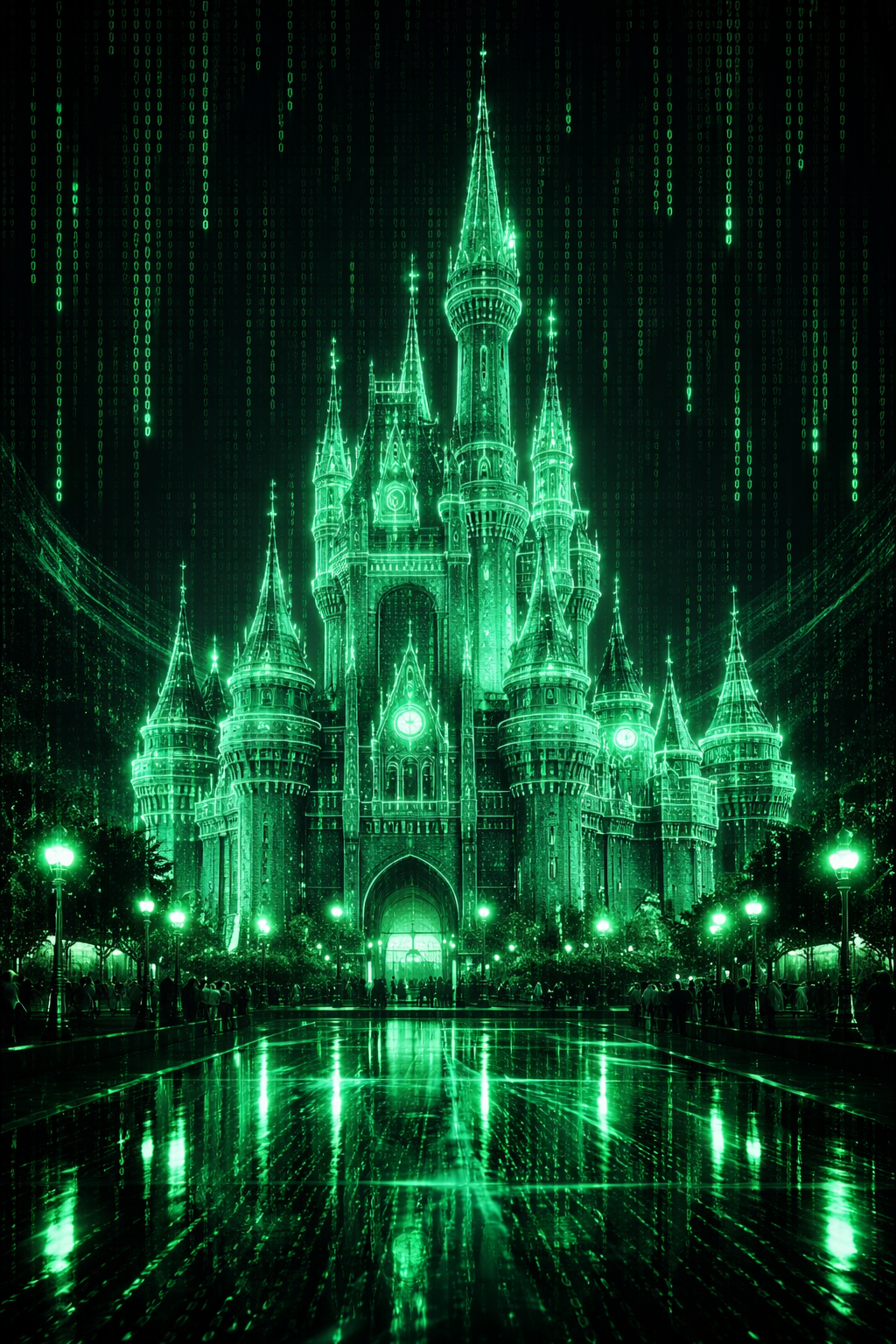
Fair Use Claimed (Generated by ChatGPT, seemingly inspired by Disney)
I dunno fam, that looks a lot like it would infringe on someone’s copyright if I used it for a use other than the fair use I’m using it for now. (But also, look at the size of that thing!)
Again, we don't know how these lines will be drawn, but there's an immediately apparent risk that Disney will be given too much control over what users generate. OpenAI's competitors might help here—if Sora won't make me a video of a theme park castle, maybe Google will—but if OpenAI has a monopoly on this type of video generation, then I see a real problem with having a massive IP-holder having the power to say "you can't use anything that we even think seems like our IP."
Altogether there are a lot of angles to this agreement. Part of me wants to throw up my hands and say "can't we just have fun anymore?!" It's the same way I felt writing about AR glasses in the parks.
But as a fan of Disney+ and a fan of the parks, I remain committed to thinking ahead and trying to understand how our relationship with the Mouse will change as new technologies come to dominate. One thing's for sure—it's going to be even more wild than the wildest ride in the wilderness (Disney, 1979).