
One of the core components of every Disney Cruise Line experience is rotational dining. In this post, we’ll dive into everything you need to know about rotational dining. We’ll cover the essentials like logistics and scheduling, along with offering our own commentary on our likes and dislikes about the whole experience. Here’s what you need to know about rotational dining for your Disney Cruise!
About This Post
This post covers rotational dining across Disney Cruise Line’s entire fleet of ships. Note that restaurants vary by ship so specific references, including photos, might not reflect your itinerary. As of this post, we’ve sailed seven itineraries on five ships across all three classes. We have a hub for Disney Cruise Line content, if you’d like to read more.
Rotational Dining Basics
Rotational dining is an innovative but easy-to-understand approach to your nightly dinner on the ship. Every Disney Cruise Line ship has three table service restaurants that are a part of rotational dining. You cannot make reservations at these restaurants or visit them for dinner outside of rotational dining. Instead, they’re built into a fixed dinner schedule.
Every night of your itinerary, whether it’s two nights or fourteen nights or some number in between, you’ll be scheduled to eat at one of these restaurants, with the three generally balanced for the itinerary (e.g. on a seven-night cruise you’ll eat at all three twice and one of them a third time).
The “rotational” part of rotational dining is that your server team will “rotate” with you for all seven dinners. This means you’ll have the same Server, Assistant Server, and Head Server for each meal.
If you’re seated at a table with other guests, those guests will also rotate with you each meal. You can put in a request for a private table as part of managing your cruise reservation. In the past we didn’t do this as a couple and were always seated with other couples. This trip, with Zoe, we requested and received a private table.
Before we move onto the dinner schedule, there’s one more minor thing to know about these restaurants. At least one of the restaurants will be open for table service breakfast and lunch every day. This won’t include any “show” components, but some can still be worth a visit. On the Disney Treasure, for example, 1923 was open for lunch. This restaurant has a lot of Disney memorabilia on display, so it was cool to have an extra, non-crowded opportunity to check it out.
Rotational dining times are built around the Broadway-style shows
Rotational Dining Schedule Basics
When you book your cruise, you’ll pick whether you want the early (usually 5:45PM) or late (usually 8:15PM) seating for dinner. The early time is more popular, and if it isn’t available when you book, you’ll be able to “waitlist” for it.
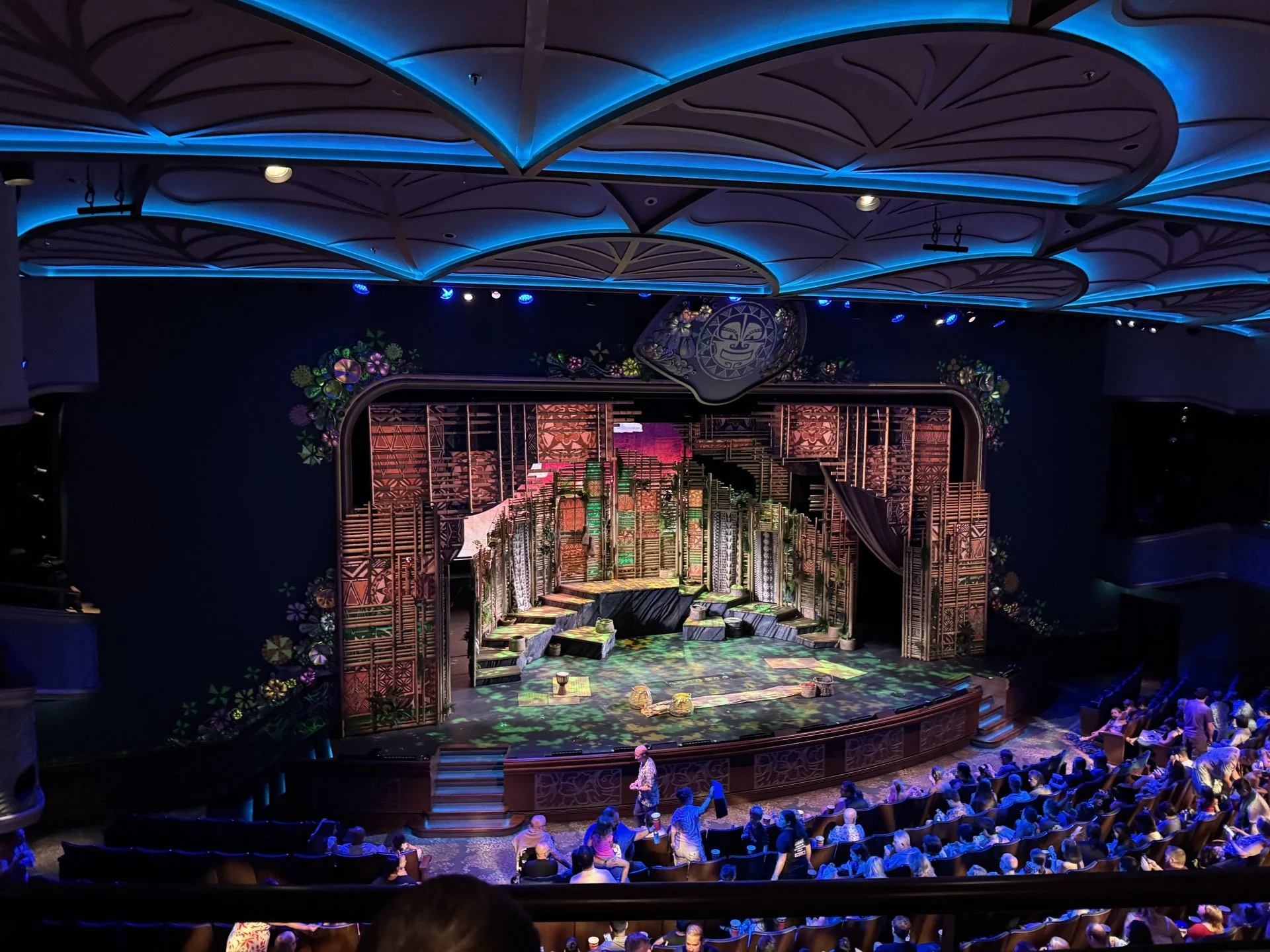
This scheduling coincides with the schedule for the feature entertainment on the cruise. At least three nights will have the “Broadway Style” shows that Disney Cruise Line is known for at 6PM and 8:30PM. If you have the early dinner you can watch the later showtime, and if you have the later dinner you can watch the earlier showtime. If you skip rotational dining, you can go to either show.
Hello, World!
For the most part, other major activities won’t be impacted by your dining schedule. However, on at least two occasions we’ve seen elements of shows on the upper decks overlap with one dining time but not the other. For example, there will be a musical performance between the two dinners but a “dance party” portion after the actual show runs past the start of the second dinner time.
Which rotational dining time is better?
Here’s a brief look at the pros and cons of each dining time. We give additional focus to families with young kids in the next section.
The early time is good for families with young kids who want to eat a nice meal together every night. The main problem is that you might be rushing at the end of your port day. You’ll also be pushing other evening activities—like the Broadway-style shows and some photo opportunities later in the evening. The early dining time can feel a bit too early, especially if you eat a late lunch. The early time is more popular, so your odds of a private table are lower.
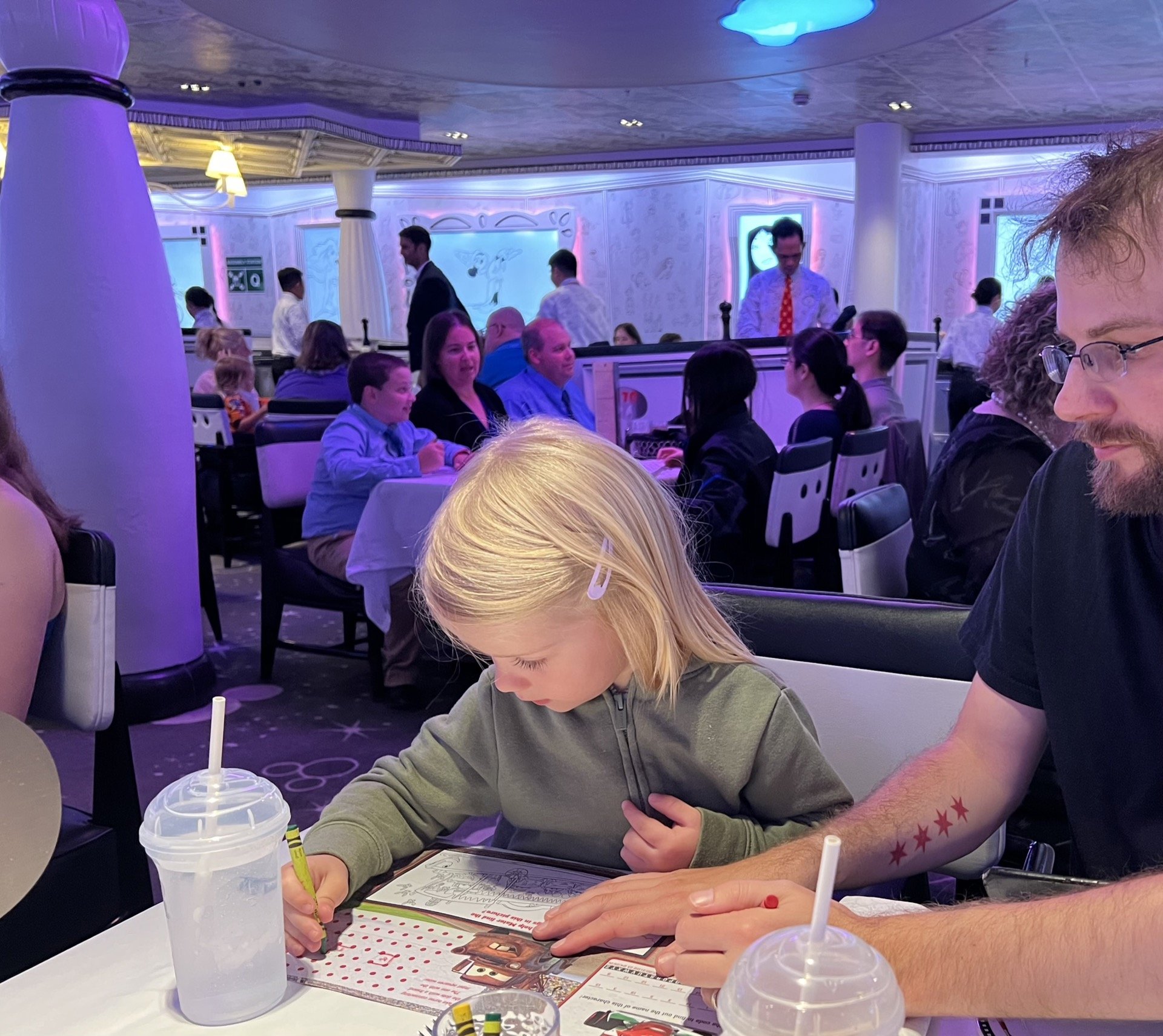
The late time allows you more flexibility for the day. You can eat a later lunch if you want, and you won’t be rushed getting back on the ship to get ready for dinner. It’s less popular, which increases the odds of a private table if you request one. Late and long meals can be tough for a small child. We’ve decided the scheduling advantages win out, though. Zoe had just turned 5 the first time we had the late dinner assignment, and our plan is to keep it moving forward.
Rotational Dining Scheduling With a Small Child
If you have small kids—we’ve cruised with one more than once—you might feel like there are big problems with either dining time. With the early dinner, they get a normal dinner time and then have to be up late, in a theater, to watch the feature entertainment. With the late dinner, you’ll fit the feature entertainment in easily but then have a potentially grumpy kid during a late dinner.
One option to deal with this is just to skip rotational dining some nights. This allows you to see the earlier showtime of the feature entertainment and eat a quick service dinner at your leisure. (We discuss alternatives to rotational dining more below.)
Or, if you have the earlier dining time, you might eat dinner and then drop your kid off at the kids’ club while you see the feature entertainment without them. The kids club will probably do a much better job of keeping them entertained and not grumpy than sitting in a theater for an hour-plus will.
Or you might mix your party up a bit, if you have multiple adults. One adult eats with the kid while the other sees the show. We never felt compelled to do this, but we’ve also skipped plenty of shows. If you have to see the shows and have a strict bedtime for your kid, a split schedule might be the best option.

Menus, Dress Codes, and Tipping
Before we shift into discussing our rotational dining likes and dislikes, I want to cover three last practical aspects of the experience—menus, dress codes, and tipping.
Menus. Within a ship, the menus for rotational dining tend to be standardized. You can look up recent menus and reviews to prepare for your trip. On cruises of more than three nights, a specialty night, like Pirate Night, will often have a uniform themed menu across all the restaurants.
As vegetarians, our experiences have been best on Wish-class ships, with earlier ships sometimes having courses without vegetarian options. If you have more dietary restrictions, the crew can usually accommodate. In our experience, we’ve always been able to have Indian food provided at a meal if we gave advance notice (for what it’s worth, this option was first presented to us by a server who deduced we didn’t love the limited vegetarian options).

Dress Codes. The dress code for the rotational dining restaurants is cruise casual. This is a low bar that basically just excludes swimwear. The official website says tank tops are not permitted, but I understand this to be, at most, limited to gym-style tank tops (bring a cardigan just to be safe).
There are sometimes formal or semiformal nights, but these are optional to participate in. Itineraries with Pirate Night will also recommend themed attire for that night.
Tipping. Tip your server team. There is a standard tip amount recommended by Disney, and an option to prepay tips via the website before your cruise. You can modify tipping amounts by visiting guest services during the cruise. Finally, you can tip in cash via envelopes that will be provided at the end of the cruise. If you choose not to go the cash route, you’ll be provided with slips indicating your prepaid amount that you can place into the envelope. Tip your server team.
Now that we’ve covered the basics of rotational dining, let’s shift to some of the nitty gritty of what we like and don’t like about how this actually plays out on the ship.
Great Things About Rotational Dining
First, here are some of the things people really love about rotational dining…
You don’t have to worry about reservations. At these three restaurants, at least, every guest is guaranteed an opportunity to dine. While the ships also offer adult-only, reservation-only, additional cost, high end dining, the rotational dining restaurants tend to be among the highlights of the ships—having a mealtime locked in saves some stress.
You’ll settle into a routine. Even if your scheduled time isn’t the one you prefer, you’ll at least be walking into a standard routine night after night. Your meal and sleep schedule might change being aboard the ship to begin with, but it’s nice it won’t be changing every night.
Disney does a good job of grouping tables. Potentially sharing tables is probably a downside for most guests, but Disney does a fine job with this, based on what we’ve seen. Young couples will typically be seated with other young couples. A parent-child duo will be paired with a parent-child duo. Two families of four might be at a table of eight, and so on.
This facilitates a lot of harmony (e.g. everyone with the small kids at late dinner knows we’re just trying to survive at this point), and you’ll know exactly whom you’ll be sitting with every night after the first night. Even as a relatively anti-social person I’ve never had a problem with the shared tables.
Your service team learns what you like and don’t like. Your experience will vary on this one, but over the course of the cruise your service team will get a sense for what you like. If you’ll always want sparkling water, you can just tell them that on night one and you’ll get it every night without asking. If you’re vegetarian, they’ll learn to assure you that you’re going to love the single vegetarian item on the menu.
You get used to your service team. Besides the practical aspect of having a team who knows your preferences, you’ll also just have a lot of reduced friction knowing, for example, whom to ask for a beverage. Or that your server likes to do a magic trick after every meal, or that they’re going to crack a lot of jokes.
The service team is really friendly. If there’s one thing the rotational dining team is known for, it’s friendliness. These are roles that depend heavily on tips and survey results (more on this below), and they deliver a level of service commensurate with what you’d expect from an expensive cruise bearing the Disney name.

Why We Usually Don’t Like Rotational Dining
I think those points in favor of rotational dining are sound, but on most cruises we still come out not liking the experience. None of these are unique to us, but some are a matter of personal preference.
Rotational dining is a big, fixed time commitment. You’re looking at about 75-90 minutes on Disney’s schedule. If you’ve had a long day of excursions, you might just want to kick back and enjoy the bars / kids’ clubs, or the feature entertainment. If you have to meet some character, you might wind up with the only option being during your mealtime. Overall, a 90-minute meal every night starts to feel a bit excessive.
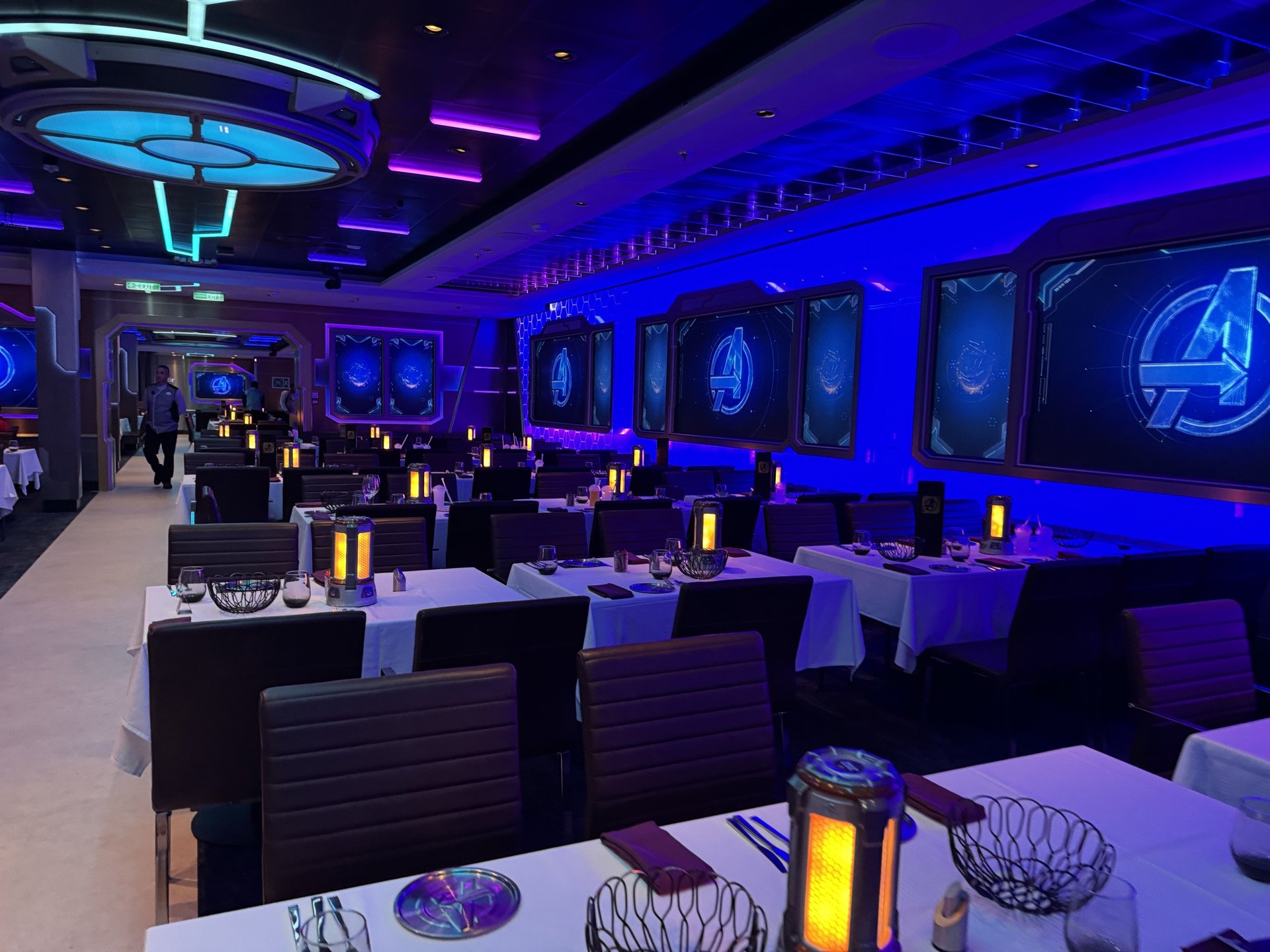
Servers can accommodate some expedited service, but your experience on this front will vary. For the more show-y dinners, like Worlds of Marvel, the payoff of the experience might not come until the very end. Sure—I’m not compelled to stay for the payoff, but think of it like a character meal where they say “well you don’t have to stay, but the character only comes after 75 minutes.”
We’re not particularly extroverted people. Rotational dining can be socially demanding on two fronts. First, even if you request a private table, you may have to share a table with other guests. As noted above, Disney does a good job with this, and we’ve never had any monsters at our table, but I could see this being hard for some people.
The other socially demanding front is the service staff. For us, the friendly attention from the rotational dining staff can be a lot to handle. Some guests, maybe most, feel the exact opposite and love the personal connections the staff will often try to form—you’ll even see people taking pictures with the Crew Members at the end of everything.
I appreciate that these are tipped positions and the crew feels the need to make a “magical experience”. But we have had servers who very much understood our vibes (see my review of the Disney Treasure, for example), and I very much believe a more calibrated level of service would be possible if not for the next problem…

The meals are understaffed. I don’t want to tell you something you might not be able to un-feel, but rotational dining is largely about cost-saving for Disney. The fixed meal times and limited menus allow for batch processing of meals. Assigning everyone a restaurant simplifies staffing. Indeed, this is why the main quick service option on the ship (Cabanas or Marceline Market) is closed during dinner—the Cast Members who work breakfast and lunch there are the rotational dining Cast Members.
One aspect of this efficiency play is understaffing. You can sometimes hear the urgency in your server’s voice as he takes your order—he has to get all these orders done in this limited time. And when you need something out of the ordinary course, it can sometimes feel like you’re a burden—they’ll assure you that it’s no problem, but you can literally see their flow being interrupted.
And this is a key point—the servers are doing an excellent job. They have the workflow down. But they’re allowed so little flexibility. Everyone chips in—I’ve seen Head Servers retrieve off-menu meals for guests who needed them. It’s great to see teamwork in action—but is it a sign of good operations that your Head Server has to leave the restaurant to run an errand?
At best, I think you’d say Disney has found the minimum level of staffing necessary to keep the experience a net positive. But the under-staffing definitely bleeds into the above issues: an understaffed meal is a slower meal (which Disney cleverly covers with show elements); an understaffed meal is a meal where the team can’t calibrate their attention to every guest’s individual needs (some need more, some need less).
The surveys are an awful guest touchpoint. This topic could be a post of its own, but I’ll get right to the point. Through no fault of the servers and much fault of higher-ups, many serving teams feel compelled to make a rather large deal about the guest surveys that all passengers are asked to complete at the end of the cruise.
They remind you once…or twice…or three times…that giving 5/5 is essential. They’ll sometimes suggest that if it hasn’t been 5/5 service, this is actually your fault for not telling them what to change (this gets experience design, which Disney leads the world in, exactly backwards).
These surveys are quite important for the livelihood of the servers, so I understand them making a big deal about it. But Disney should fix this. It creates unnecessary friction between guests and servers, and it can make the entire positive experience of rotational dining feel transactional as the cruise wraps up.
Alternatives to Rotational Dining
Perhaps the biggest downside of rotational dining is that there aren’t great alternatives. As noted above, the rotational dining team usually staffs Cabanas / Marceline Market during breakfast and lunch, so that primary quick service option is closed during dinner.
Some combination of the smaller, poolside quick service restaurants will remain open during dinner. The problem with these is that, depending on the length of the cruise and your schedule, you might already be having several lunches at these. Over, say, a seven-night cruise with multiple days at sea, you’ll have a lot of pizza, burgers, and burritos.
There are also the reservation-only, adult-only, additional cost upscale dining options. Restaurants like Remy, Palo, and Enchante are definitely a good break from rotational dining, but even if you’re willing to spend the cost, they won’t be a perfect substitute for rotational dining. Besides not allowing kids (which may or may not be a problem for you), there are often restrictions on how many times you can dine at these restaurants, and reservations are limited in any case.

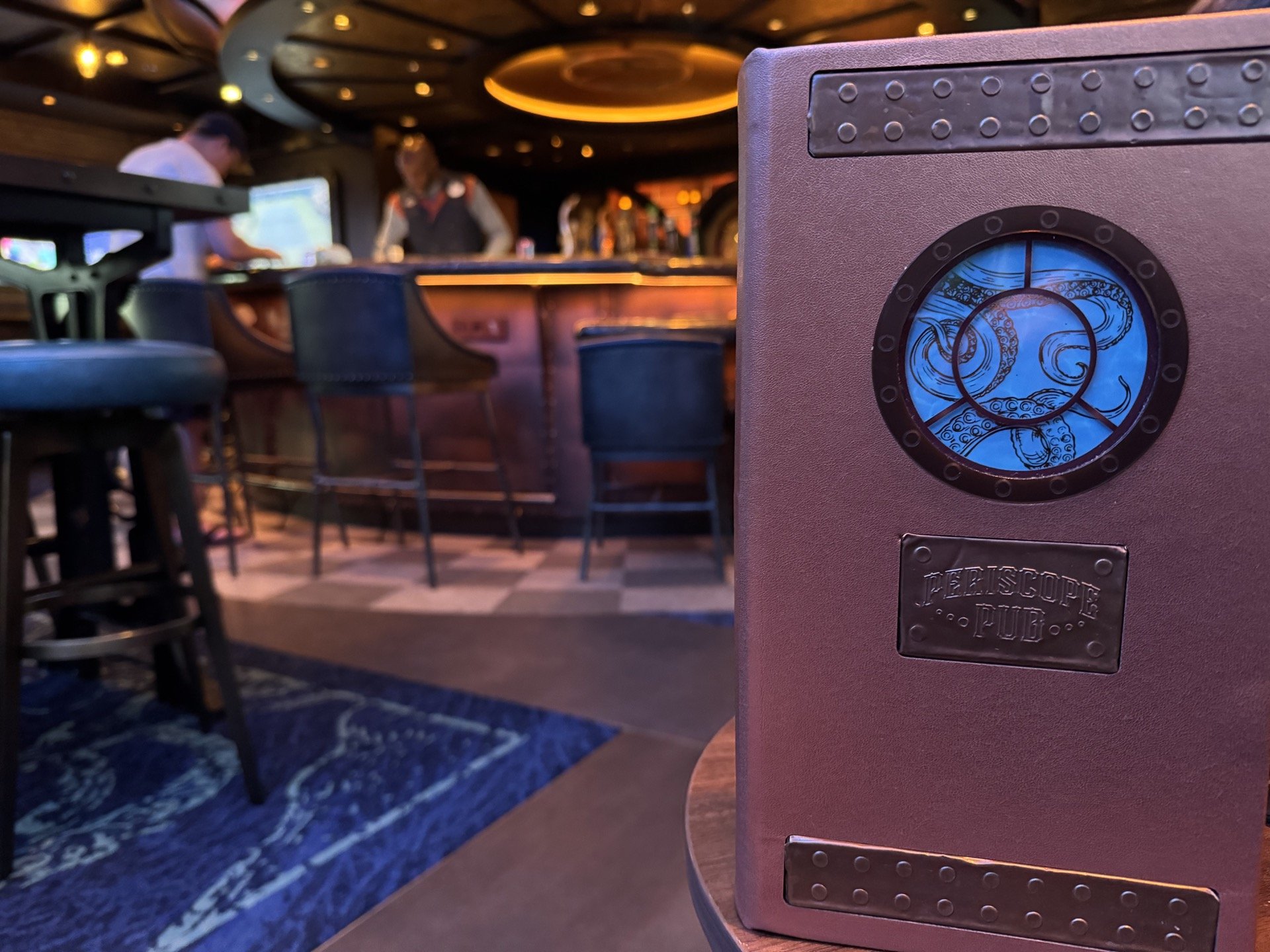
The pub-style bar usually has a limited food menu. Each ship has some bar that is something of a pub or beer bar, and it usually has a small food menu with things like wings and pretzels.
Finally, there’s room service. I’ve long loved room service and definitely understand people enjoying it, but it is a bit disappointing that by the latter half of your cruise this might be your best option for dinner.
Closing Thoughts
Distinctive as it is, rotational dining represents a bit of a compromise for Disney. They’re aiming for an efficient way to make sure every guest has access to the same, standardized set of high-level dining experiences. Through seven sailings with Disney Cruise Line, we’ve felt the final product is a bit of a mixed bag.
The low point here is the handling of guest surveys—an area where Disney’s approach is bad for guests, servers, and their own data integrity (since people are pressured to give high scores). Disney should hold itself to a high standard and accept that this approach simply doesn’t work.
Beyond that, I have to concede that my demands for both more quick service options during dinner and more rotational dining staff are probably asking a bit too much.
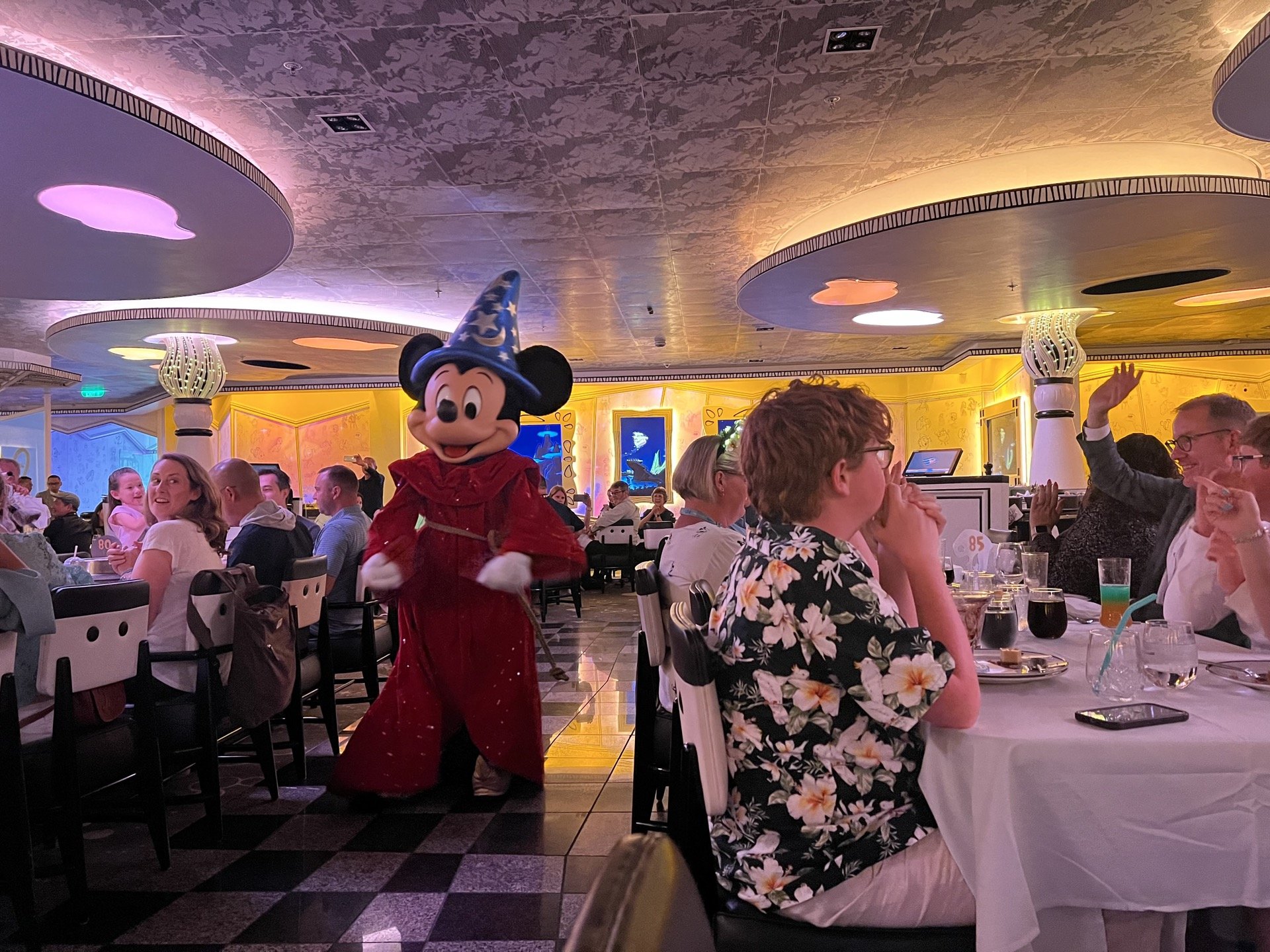
But the bottom line for rotational dining is that it works. We’re talking about restaurants with Marvel-themed shows and character appearances, Frozen performances, the chance to talk to Crush (the turtle from the movie) from your dinner table, and more. Plus three Broadway-style shows timed around the meals.
Disney has contrived a way to get every guest into all those experiences in straightforward fashion. If you can get to the end of your day with the level of chill necessary to just let the rotational dining experience happen to you, you’ll probably wind up satisfied.